Hello Yellow
Analysis of the Toning Spectrums
Nobody knows toning better than Doug Kurz, owner of Sunnywood's "Somewhere Over the Rainbow" Toned Morgans. This is the first and only (that I know about) complete set of Rainbow Toned Morgan dollars. This article addresses the yellow and gold toning spectrums of Rainbow Morgan dollars.
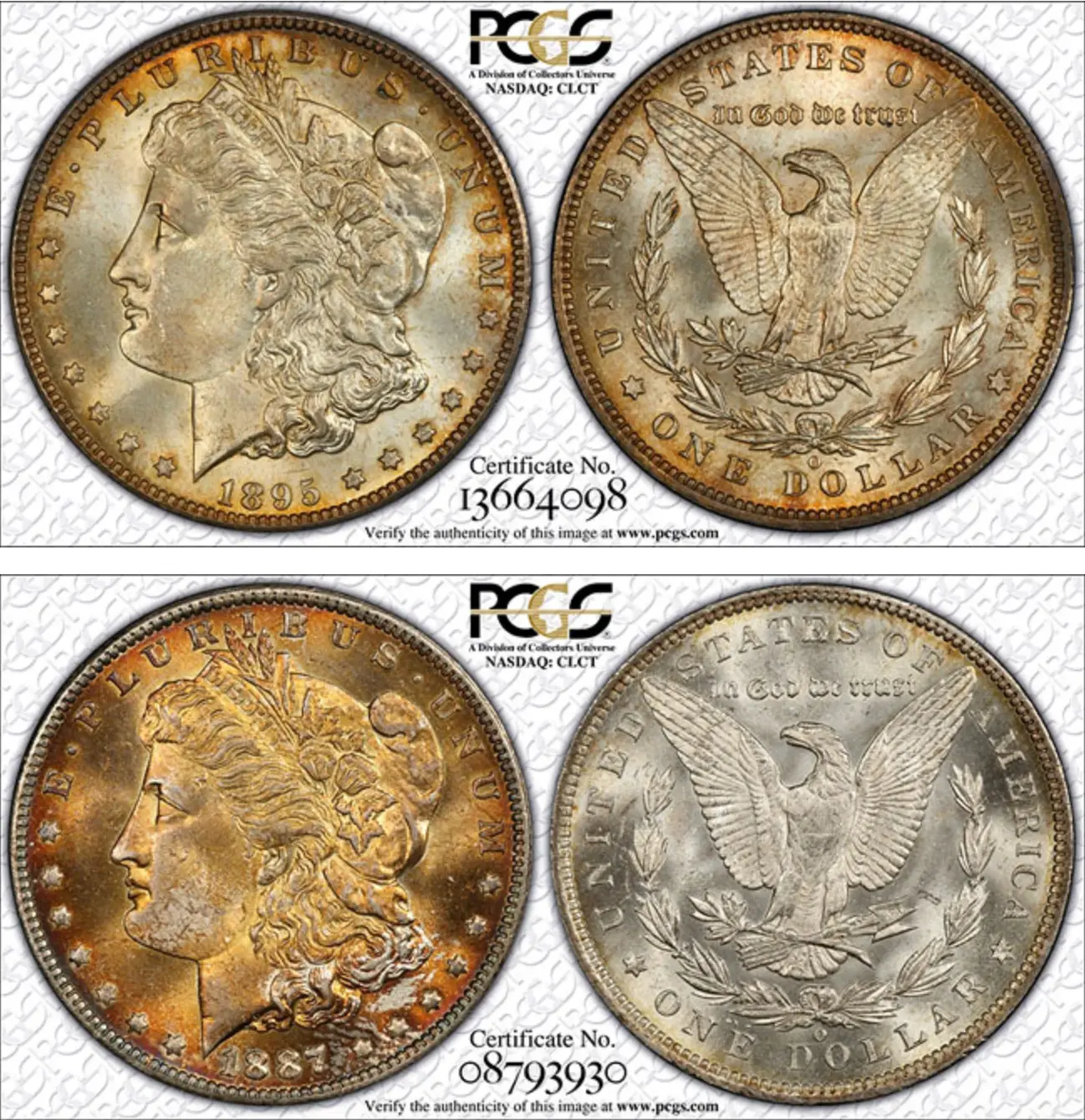
The first colors in the natural thin film toning progression are various shades of gold. In my classification system, I refer to them as light gold (class A), medium gold (class B), and amber (class C) to russet (class D). These are "first cycle" colors. Further along in the progression, we return to some colors that are more *yellow*. In my system, these include lemon yellow (class I), sunset yellow (class J), to orange (class K); these are "second cycle" colors. The point of the class designations is to show you where these colors fall in the progression. There is also a thrid cycle gold (class S) which is much more rare, and has an altogether different appearance.
It is possible to have a coin toned almost entirely in one color class. That essentially means that the toning layer is extremely uniform in thickness. This is much more likely on a small diameter coin; almost all larger colorfully toned coins will tend to exhibit multiple color classes. One way to achieve an extremely uniform coloration is through artificial toning - specifically, by heating in air to a controlled temperature, and allowing the coin to oxidize uniformly. However, it is also possible (although generally quite uncommon) to have uniform colors through natural toning. Usually in the natural toning, there will be some non-uniformities, e.g. in the recessses or at the perimeter. The heat-toned coins are usually too obvious - way too uniform and perfect.
Here are examples of first cycle gold colors, classes A & B (1895-O dollar), and class C (1887-O dollar):
Contrast the above with the more yellow second cycle colors (classes I, J) in these coins (I don't have any where it covers the entire coin, but it is theoretically possible, and much more likely on a smaller diameter coin):
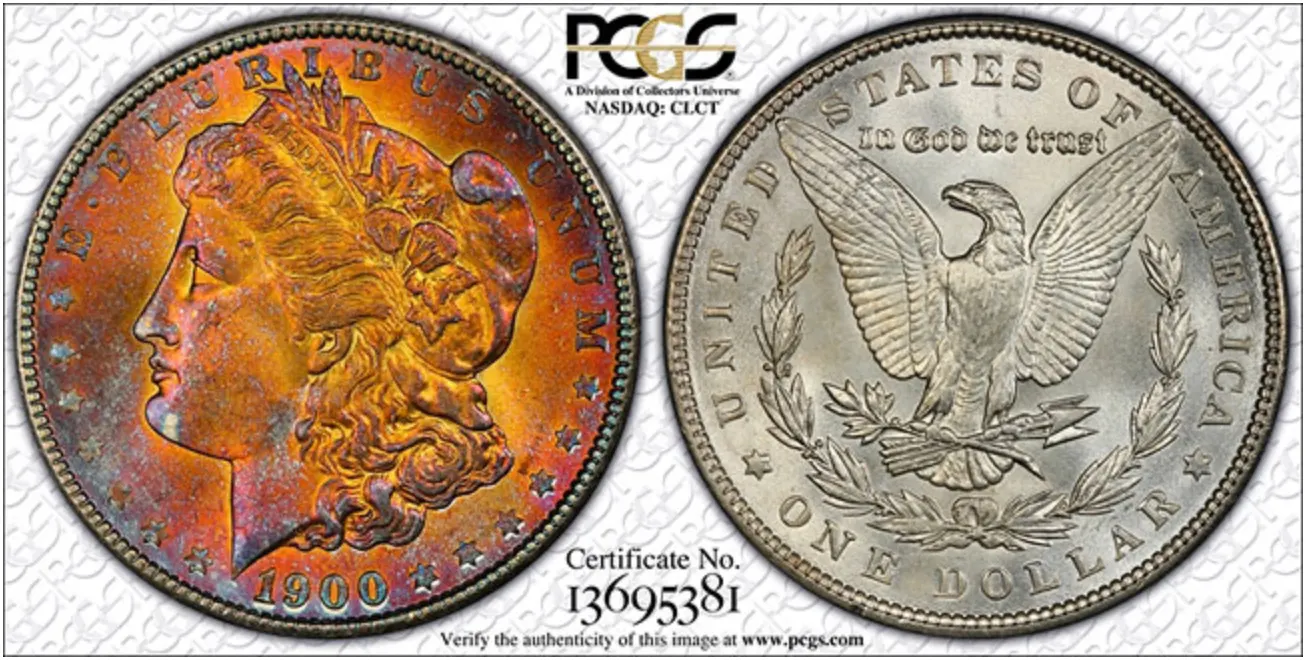
This one ranges from sunset yellow through orange (class K) and beyond:
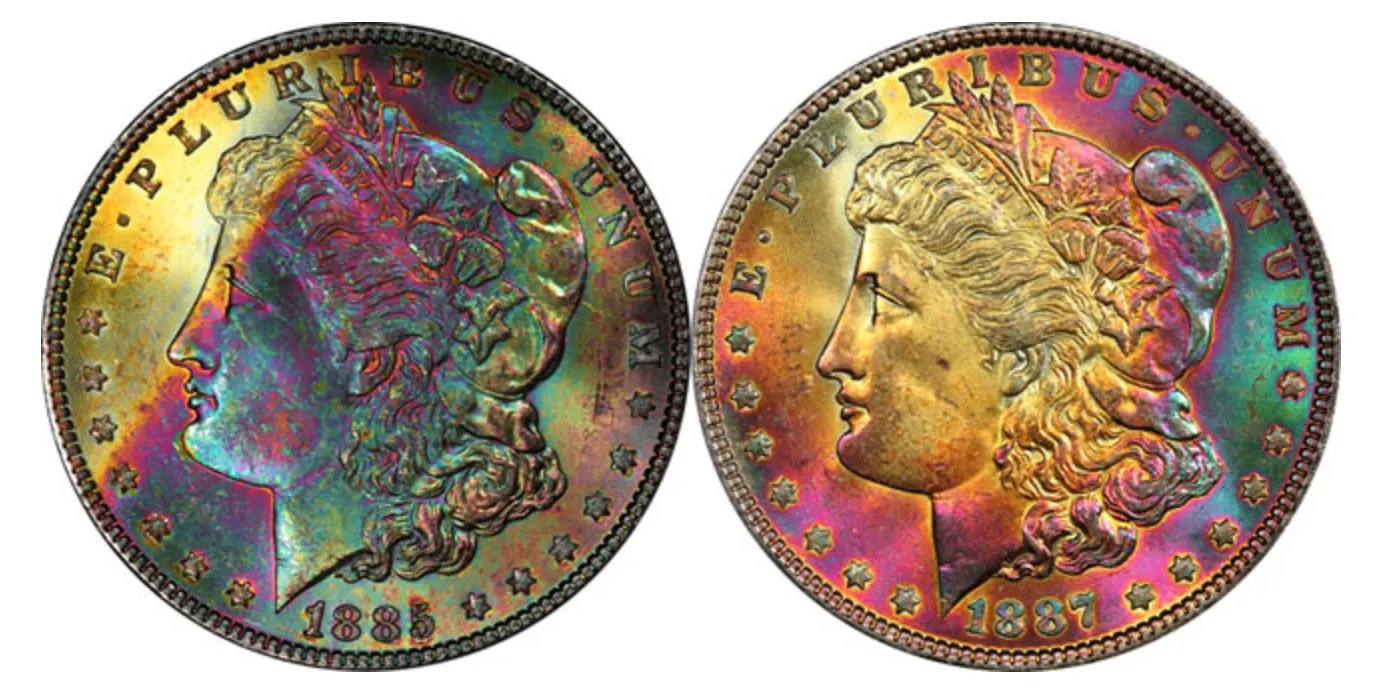
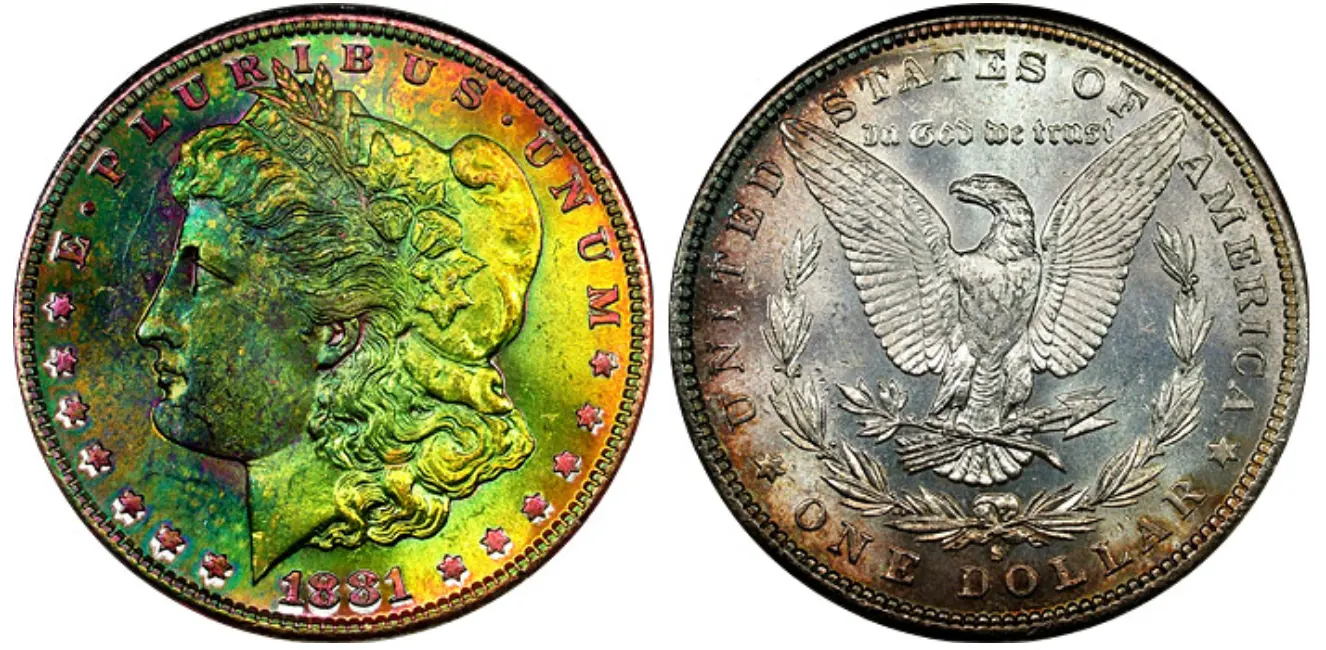
Here are two coins with a nice amount of the rare third cycle gold, which comes after emerald green in the progression.
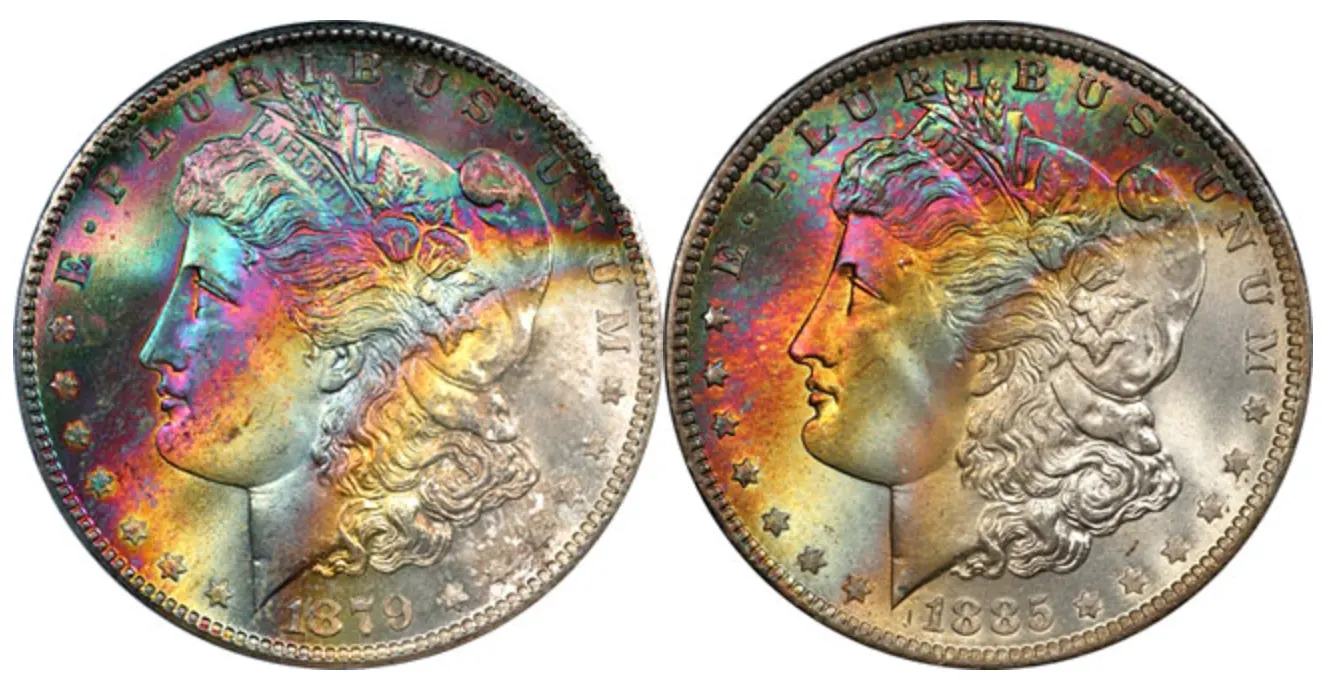
Finally, here are some banded rainbow toners that show the first cycle gold/amber (next to the untoned silver area) and second cycle yellows, in the context of a more complete spectrum of toning:
Anyway, I hope this helps to show the different kinds of golds and yellows that are possible with natural (or artificial) toning. The natural toning will always show some gradations in color, even if subtle.
Arguments and Rebuttals:
That 1st coin appears to have the classic dip stain toning. Just not fully rinsed after it was dipped. But still attractive, probably took many years to get that way.
The others are probably AT, I have learned to steer very clear of those one sided toners, the tone boys are getting particularly good at the one sided AT.
Sorry but you are completely mistaken. The gem 1895-O dollar is pedigreed to the Norweb collection and appears never to have been dipped (unlike some of the other Norweb coins, such as the 1893-S, which sadly suffered a different fate after the Norwebs sold it). Dip stain toning tends to be streaky, as one would expect from a liquid residue pattern, very different from the radially symmetric target distribution of the toning on this 1895-O (i.e. the toning clings concentrically to the perimeter). This coin has a pedigree back to 1908, when the Holdens bought it from J.W. Scott, and is believed to have been purchased directly from the New Orleans Mint by J.W. Scott in the year of issue, and held by him until 1908. (That is Dave Bowers' theory, not mine.) We can be sure that it has not been dipped, at least since 1908, if ever. The coin has acquired slightly more color since the Norweb Sale.
As for the other coins, they are not even remotely AT. A better familiarity with the history of Morgan dollars and their unique rainbow bag toning would lead you to a different and more accurate conclusion.
However, I do very much agree that it is wise to avoid collecting areas that you are less familiar with.
I've had some loose 2005 bison nickels sitting in a brown Nike shoebox since 2005 and they have turned a bright gold color. What in the shoebox could have caused the golden color?
BBN, the colors in toning are caused by the thin film interference effect, which I have written about in other threads. If the environment in your shoebox caused the copper-nickel surfaces of your coins to develop an oxide-sulfide surface film (through natural chemical reactions), and if the film has the right thicknesses to produce yellow or gold toning, then you get gold-toned coins as a result.
The point of this article is to demonstrate that yellows and gold do occur throughout the natural toning color progression that results from the thin film interference effect. There are 1st cycle gold and amber colors, 2nd cycle yellow and orange colors, and the unique 3rd cycle gold color which is more rare, and beautiful. This can happen on nickels just as on silver coins. Wild colors are seen more often on Morgans only because of their unique specific history.
Article by: Doug Kurz (dkurz@mindspring.com)
Compiled and Edited by Brandon Kelley (brandon@jhonecash.com)
Edited and reprinted here from Doug Kurz's Article on the PCGS message boards with the permission of Doug Kurz.